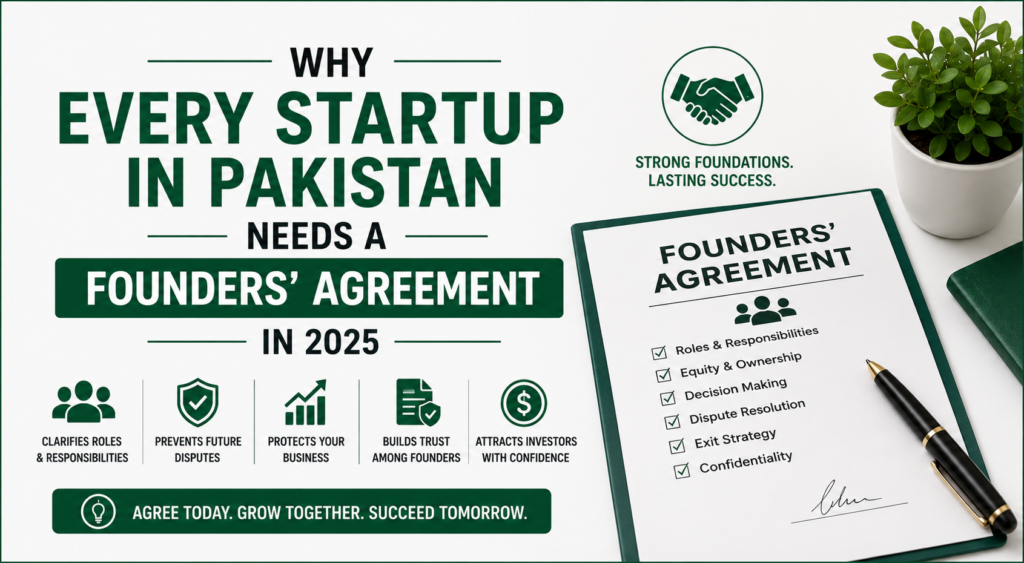
Launching a startup in Pakistan is exciting but also risky. Most founders spend months perfecting their product, building an MVP, or running marketing campaigns, yet fail to lock the most important legal document that actually protects the startup’s future: the Founders’ Agreement.
A founders’ agreement outlines who owns what, who does what, and what happens if things go wrong. Without it, even the most promising startups collapse because of internal disputes, unclear responsibilities, or disagreements about equity.
In 2025, with the startup ecosystem expanding rapidly in Karachi, Lahore, and Islamabad, investors want one thing before committing funds:
A clear, complete, and legally strong founders’ agreement.
This guide will help you understand exactly how to draft one.
A Founders’ Agreement is a legally binding contract between co-founders of a startup that outlines.!
Equity splits
Roles and responsibilities
Intellectual property ownership
Decision making rights
Vesting schedules
Exit terms
Dispute resolution
Think of it as the constitution of your startup. If anything goes wrong between founders this document decides what happens next.
Over 60% of Pakistani startups shut down due to internal disputes.
A founders’ agreement prevents misunderstandings and sets the rules from day one.
Without proper clauses, any founder could claim ownership of.!
Your branding
Your code
Your product idea
Your designs
A founders’ agreement ensures all IP belongs to the company.
Investors especially from PSEB, NIC, or international funds will not invest until they review your founders’ agreement.
Instead of emotional decisions, the agreement clearly defines.!
Who owns how much
How equity changes over time
What happens if someone leaves
A founders’ agreement reduces.
Lawsuits
Ownership disputes
Financial conflicts
Idea theft
Below are the core components every founders’ agreement must include.
This is the number one cause of disputes.
Your agreement must answer:
How much equity does each founder get?
Is equity based on work or money invested?
Will equity dilute when new investors join?
Pro Tip: Avoid a 50/50 split investors don’t like deadlocks.
Clearly define:
CEO duties
CTO responsibilities
CMO or COO tasks
Who controls finances
Who manages product development
This prevents duplication of work and future conflicts.
This clause ensures all work code, branding, marketing material, algorithms belongs to the company, not individuals.
Without this clause, a founder could quit and legally take your product with them.
A vesting schedule means a founder earns their equity over time.
Example: 4 year vesting with a 1 year cliff
This protects the company if a founder leaves early.
Clarify.!
Who gets paid and when
Reimbursement policy
Salary structure after funding
Founders often argue when money enters the picture.
Define.!
Who makes key decisions
What requires unanimous approval
What decisions the CEO can make alone
Always include.!
Mediation
Arbitration
Jurisdiction (usually Karachi, Lahore, Islamabad courts)
This prevents unnecessary lawsuits.
Important questions.!
What happens if a founder leaves?
Can a non performing founder be removed?
What happens to their equity?
Without these provisions, your startup becomes vulnerable.
A Karachi based tech startup with three co-founders had equal equity splits.
Two founders left within 8 months, yet they still owned 66% equity.
Investors rejected the startup instantly.
Why?
They did not have a vesting clause.
Prevents conflicts
Protects startup assets
Builds investor confidence
Ensures accountability
Protects against idea theft
Requires legal expertise
Time consuming to draft
Needs updates after funding
Solution: Hire an experienced law firm such as MAH&CO.
MAH&CO. is one of Pakistan’s top full service business law firms helping startups, creators, tech founders, SaaS businesses, and SMEs build legally secure companies.
Drafts professional founders’ agreements
Ensures legally compliant equity splits
Protects your intellectual property rights
Drafts NDAs, shareholder agreements & employment contracts
Helps register your business with SECP & FBR
Advises on foreign investment, SAFE notes, and ESOP policies
Provides ongoing legal support as your startup grows
Whether you’re a SaaS founder, fintech innovator, or e-commerce startup MAH&CO. creates legally strong documentation that investors trust.
It is a contract between startup co-founders that outlines equity, roles, responsibilities, IP ownership, and dispute resolution.
Not required, but highly recommended, especially before raising investment.
Yes, but it increases the risk of disputes and investor rejection.
A qualified lawyer or law firm like MAH&CO. to ensure legal enforceability.
A vesting schedule prevents them from keeping unearned equity.