What Is the Pakistan Names and Emblems Act, 1957?

If you’ve ever searched, “What is the Pakistan Names and Emblems Act and can I use government logos in my business?” you’re asking one of the most practical yet overlooked questions in Pakistani commercial and intellectual property law.
 
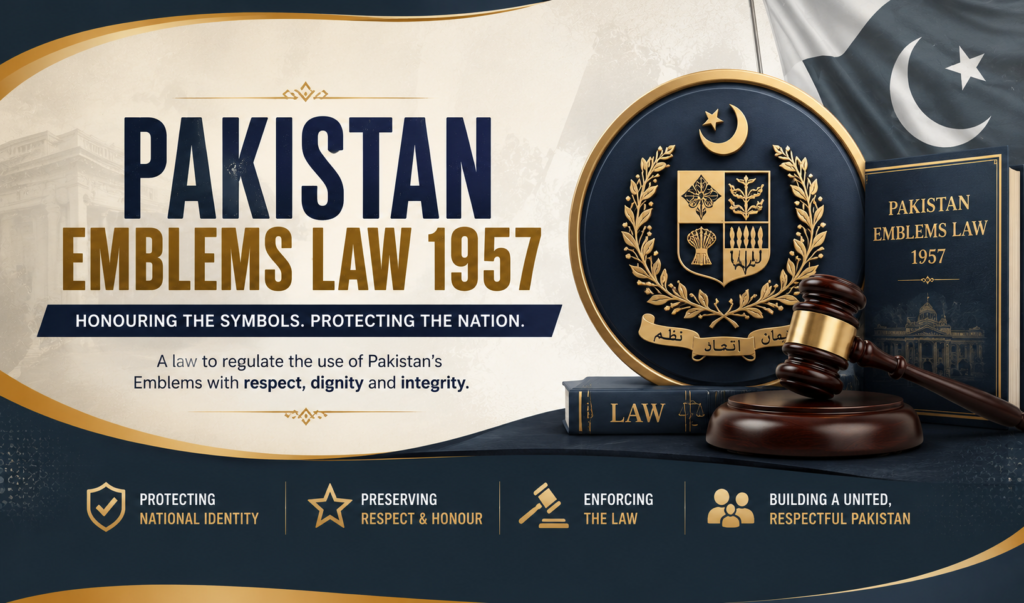
The Pakistan Names and Emblems (Prevention of Unauthorized Use) Act, 1957 is a federal statute that prohibits the unauthorized use of official names, emblems, insignia, and titles associated with the Government of Pakistan, its institutions, and international organizations to which Pakistan belongs. Enacted to protect state identity and prevent commercial fraud, the Act makes it illegal to use protected symbols for trade, advertising, or deceptive purposes without prior government authorization.
 
In simple terms: if you’re designing a product label, running an advertisement, registering a trademark, or publishing content that includes words like “Government of Pakistan,” the national emblem, military insignia, or official titles, this law determines whether your use is lawful or constitutes a punishable offense.

Historical Background: Why Was This Law Created?

To understand this Act, we need to look at Pakistan’s early years as an independent nation.

Post Independence Identity Protection (1947-1957)

After gaining independence in 1947, Pakistan faced the dual challenge of building state institutions while protecting their integrity from misuse. During this period:

  • Commercial entities sometimes used government-associated names to imply official endorsement
  • Fraudulent schemes exploited public trust in state symbols
  • International organizations required member states to protect shared emblems (UN, Commonwealth, etc.)

Enactment of the Act (1957)

In response, Parliament passed the Pakistan Names and Emblems (Prevention of Unauthorized Use) Act, 1957 to:

1) Define protected names and emblems of the state and its institutions
2) Prohibit unauthorized commercial or deceptive use of these symbols
3) Establish penalties for violations, including fines and imprisonment
4) Provide exceptions for legitimate news reporting, academic use, and authorized government purposes
 
The legislation was influenced by similar laws in Commonwealth jurisdictions and reflected Pakistan’s commitment to maintaining the dignity and exclusivity of state identity markers.

Evolution Through Decades

While the core provisions remain unchanged, the Act’s application has evolved with:

  • The rise of digital media and e-commerce
  • Expanded trademark and intellectual property frameworks
  • Increased international cooperation on emblem protection
  • Constitutional jurisprudence balancing state interests with free expression
 

Key Provisions Simplified: What Does the Act Actually Say?

Let’s break down the most important sections in clear, accessible language:

Section 2: Protected Names & Emblems Defined

Category
Examples
Why It Matters
Government Titles
“Government of Pakistan,” “Federal Government,” “Provincial Government”
Prevents businesses from implying official endorsement
Official Positions
“President,” “Prime Minister,” “Chief Justice,” “Chief of Army Staff”
Protects against impersonation or misleading associations
State Institutions
“Parliament,” “Supreme Court,” “Pakistan Armed Forces,” “ISI”
Safeguards institutional reputation and public trust
National Symbols
National emblem, flag, state seal, official mottos
Preserves national identity and prevents commercial exploitation
International Emblems
UN, OIC, Commonwealth logos (where Pakistan is a member)
Fulfills treaty obligations and prevents diplomatic confusion

Section 3: Prohibited Uses

The Act makes it unlawful to use protected names or emblems:

  • In any trade, business, or commercial activity without authorization
  • In a manner that suggests official approval, sponsorship, or connection
  • For deceptive, fraudulent, or misleading purposes
  • In advertising, packaging, labeling, or promotional materials without permission
 
Why this matters: Even unintentional use can trigger legal consequences. A small business using “Pakistan Government Approved” on product packaging, or a startup incorporating “Supreme Court” in its brand name, could face penalties under this Act.

Section 4: Exceptions & Permitted Uses

The law recognizes legitimate uses that do not require authorization:

  • News reporting and journalism: Media outlets may reference official titles in factual reporting
  • Academic and research purposes: Scholarly works may use protected terms for analysis or critique
  • Authorized government communications: Official publications, press releases, and public notices
  • Incidental or descriptive use: Using “Pakistan” as a geographic descriptor (e.g., “Made in Pakistan”) is generally permissible

Section 5: Penalties for Violation

Violation Type
Potential Penalty
First-time unauthorized commercial use
Fine up to PKR 5,000 (historical amount; subject to inflation adjustments)
Repeated or deliberate misuse
Imprisonment up to 6 months, higher fines
Fraudulent intent or significant harm
Enhanced penalties at court’s discretion
Important Note: While the monetary penalties appear modest by today’s standards, the reputational damage, business disruption, and potential civil liability can be substantial.

Modern Application: How Does This Law Operate Today?

While enacted in 1957, this Act remains relevant in contemporary legal practice. Here’s how it intersects with modern scenarios:
 
Current Applications in Pakistan
 
Scenario
How the Act Applies
Trademark Registration Disputes
IPO Pakistan may reject applications containing protected names/emblems without authorization
Advertising & Marketing Compliance
Brands must avoid implying government endorsement without written permission
Digital Content & Social Media
Websites, apps, or influencers using official emblems without authorization risk takedown notices or legal action
Product Labeling & Packaging
Export-oriented businesses must ensure labels don’t misuse state symbols
Corporate Naming & Branding
Company names cannot incorporate protected titles without approval
Overlapping Laws & Legal Frameworks
The Act doesn’t operate in isolation. Key intersections include:
  • Trademarks Ordinance, 2001: Governs registration and protection of commercial marks; conflicts with protected emblems are resolved in favor of state symbols
  • Pakistan Penal Code, 1860: Sections on cheating, fraud, and impersonation may apply alongside the 1957 Act
  • Prevention of Electronic Crimes Act, 2016: Digital misuse of official emblems may trigger cybercrime provisions
  • Constitution of Pakistan, 1973: Article 19 (freedom of speech) may be invoked in defense of legitimate journalistic or academic use
 
Practical Reality: Most enforcement today occurs through:
  • IPO Pakistan’s trademark examination process
  • Federal Investigation Agency (FIA) cybercrime wing for digital violations
  • Civil suits for trademark infringement or unfair competition
  • Administrative actions by relevant ministries
 

Common Legal Issues We See in Practice

Based on decades of intellectual property and commercial law experience at MAH&CO., here are the most frequent matters involving this Act:

Issue #1: Trademark Registration Rejections

Scenario: A business applies to register a brand name containing “Pakistan” or an official emblem, and IPO Pakistan rejects it citing the 1957 Act.

Legal Strategy:
  • File a review petition demonstrating legitimate, non-deceptive use
  • Seek written authorization from the relevant government department
  • Amend the application to remove or modify the protected element

Issue #2: Advertising Compliance Challenges

Scenario: A marketing campaign uses language or imagery that implies government endorsement without authorization.

Defense Approach:
  • Demonstrate that the use was incidental, descriptive, or newsworthy
  • Show lack of intent to deceive or commercially exploit state symbols
  • Negotiate corrective measures (revised ads, public clarification) to mitigate penalties

Issue #3: Digital Content Takedown Requests

Scenario: A website or social media account is flagged for using the national emblem or official titles without permission.

Response Strategy:
  • Verify whether the use falls within permitted exceptions (news, education, criticism)
  • If unauthorized, promptly remove or modify the content to avoid escalation
  • Document good-faith efforts to comply if contesting the takedown

Issue #4: Constitutional Free Speech Defenses

Scenario: A journalist, artist, or activist is threatened with legal action for using protected terms in expressive work.

Legal Avenue:
  • File constitutional petition invoking Article 19 (freedom of speech)
  • Argue that the use was legitimate commentary, parody, or public interest reporting
  • Cite precedents balancing state interests with fundamental rights

How MAH&CO. Can Help With Names & Emblems Legal Matters

Navigating the Pakistan Names and Emblems Act requires precise legal strategy that balances commercial objectives with statutory compliance. At MAH&CO., our barrister-led team provides experienced counsel for businesses, creators, and individuals facing questions or allegations under this legislation.
 
Our Legal Services Include:
  • Trademark Strategy & IPO Representation: Guiding brand registration to avoid conflicts with protected names/emblems
  • Advertising Compliance Reviews: Pre-clearing marketing campaigns to ensure lawful use of official references
  • Defense Against Unauthorized Use Allegations: Representing clients in administrative, civil, or criminal proceedings under the 1957 Act
  • Constitutional Petitions & Free Speech Defense: Protecting legitimate journalistic, academic, or expressive uses under Article 19
  • Digital Content & Cyber Law Advisory: Advising on lawful use of state symbols in websites, apps, and social media
 
Related Legal Expertise at MAH&CO.:
  • Facing criminal allegations related to trademark fraud or impersonation? Our best criminal defence lawyer in Karachi team provides robust representation under the PPC, PECA, and specialized statutes.
  • Need intellectual property protection for your brand? Our copyright & intellectual property lawyers handle trademark registration, enforcement, and portfolio management across Pakistan.
  • Seeking comprehensive commercial legal support? As the best law firm in Karachi, MAH&CO. integrates regulatory compliance, litigation strength, and strategic advisory to protect your business interests.
 
Schedule a Confidential Consultation: If you have questions about the Pakistan Names and Emblems Act, need pre-clearance for branding or advertising, or are responding to a legal notice, contact our team today. We offer free initial consultations to assess your situation and discuss practical legal pathways.
 
Karachi Office: Office No. 401, 4th Floor, Elegant Tower, Block 5 Clifton
Islamabad Office: House No. 409-B, Street 20, NPF Society, E-11/4
Phone: +92 3458231881
Email: info@mahlegal.org | a.karim@mahlegal.org
 

Generally, no. The Pakistan Names and Emblems Act, 1957 prohibits unauthorized commercial use of the national emblem. Using it in a business logo, product packaging, or advertising without written government authorization may result in fines, trademark rejection, or legal action. If you believe your use qualifies for an exception (e.g., educational content), consult a criminal lawyer in Karachi to assess your specific situation.

IPO Pakistan will likely reject your trademark application citing the 1957 Act. You may file a review petition demonstrating legitimate use or amend the application to remove the protected element. If the mark is already registered, the government may seek cancellation. Early legal consultation can help navigate this process efficiently.

Not necessarily. The Act prohibits unauthorized commercial or deceptive use. Factual references in news articles, academic research, or legitimate business descriptions (e.g., "We supply to Government of Pakistan agencies") are generally permissible. However, implying official endorsement without authorization crosses the line. When in doubt, seek legal advice.

Yes, using "Pakistan" as a geographic descriptor (e.g., "Pakistan Textiles Ltd.") is typically allowed. However, incorporating protected titles like "Government," "Federal," "Supreme Court," or official emblems requires authorization. IPO Pakistan and the Securities and Exchange Commission review company names for compliance during registration.

Do not ignore it. Immediately consult a best criminal defence lawyer in Karachi or your local jurisdiction. Key steps: (1) Review the notice to understand the alleged violation, (2) Preserve all relevant documents and communications, (3) Assess whether your use qualifies for an exception, (4) Respond through legal counsel to negotiate resolution or prepare a defense. Early intervention significantly improves outcomes.