
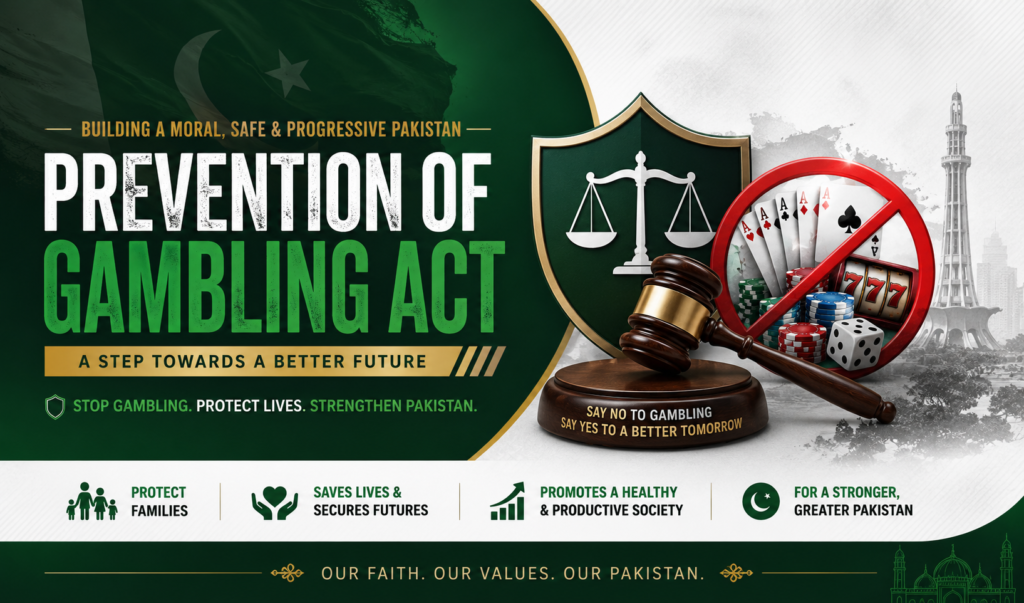
What Is the Prevention of Gambling Act, 1977?

If you’ve ever searched, “What is the Prevention of Gambling Act in Pakistan and can I run a raffle or lottery legally?” you’re asking one of the most practical yet frequently misunderstood questions in Pakistani criminal and regulatory law.
 
The Prevention of Gambling Act, 1977 is a federal statute that prohibits unauthorized gambling, betting, wagering, and games of chance across Pakistan. Enacted to address rising concerns about illegal gambling dens, fraudulent schemes, and social harms associated with unregulated betting, the law establishes criminal penalties for operating gambling establishments, participating in unlawful games, and promoting lotteries without government authorization.
 
In simple terms: if you’re organizing a card game for money, running a betting platform, hosting a lottery, or operating any game where chance determines outcomes and money changes hands, this law determines whether your activity is lawful entertainment or a punishable offense.

Historical Background: Why Was This Law Enacted?

Understanding this Act requires examining Pakistan’s social and legal landscape in the 1970s.

Pre-1977: The Legal Gap

Before 1977, gambling-related offenses were addressed primarily through:

  • Pakistan Penal Code, 1860: Sections 294A (keeping a lottery office) and related provisions
  • Public Gambling Act, 1867: A colonial-era law with limited enforcement mechanisms
  • Provincial police regulations: Inconsistent approaches across regions
 
These frameworks proved inadequate for addressing:
  • Emerging underground gambling networks
  • Cross-border betting operations
  • Fraudulent lottery schemes targeting vulnerable populations
  • Social concerns about addiction and financial harm

Enactment of the Act (1977)

Parliament passed the Prevention of Gambling Act, 1977 to create a unified, enforceable framework. The legislation aimed to:

1) Define gambling, betting, and wagering with sufficient clarity for enforcement
2) Prohibit unauthorized gambling establishments and related activities
3) Establish penalties including fines and imprisonment for violations
4) Empower law enforcement with search, seizure, and arrest authority
5) Provide limited exceptions for authorized lotteries and skill-based competitions

Post-1977: Evolution & Modern Challenges

While the core provisions remain intact, the Act’s application has evolved through:

  • Judicial interpretation distinguishing games of skill vs. chance
  • Technological advances enabling online gambling and betting platforms
  • Provincial variations in enforcement priorities and resources
  • Constitutional challenges balancing personal liberty with public morality

Key Provisions Simplified: What Does the Act Actually Say?

Let’s break down the most important sections in clear, accessible language:

Section 2: Critical Definitions

Term
Legal Meaning
Practical Impact
Gambling
Playing any game of chance for money or valuable consideration
Determines if an activity falls under the Act’s prohibitions
Common gaming house
Any place used for gambling where the owner profits from the activity
Operating such a venue is a criminal offense
Betting/Wagering
Staking money on uncertain events (sports, races, etc.)
Covered under the Act’s prohibitions
Lottery
Distribution of prizes by chance among ticket purchasers
Requires specific government authorization to be legal

Section 3-5: Prohibited Activities & Penalties

Violation
Legal Consequence
Keeping or managing a common gaming house
Imprisonment up to 1 year, fine up to PKR 5,000, or both
Being found gambling in a public place
Fine up to PKR 500, possible imprisonment
Promoting or advertising unauthorized lotteries
Fine, imprisonment, or both at court’s discretion
Possessing gambling equipment with intent to use
Presumptive evidence of violation; penalties apply

Section 6-8: Enforcement Powers

Law enforcement officers are empowered to:

  • Enter and search premises suspected of being used for gambling
  • Seize gambling equipment, records, and proceeds
  • Arrest without warrant individuals found committing offenses under the Act
  • Require identification from persons found in suspected gambling venues

Section 9-10: Exceptions & Defenses

The Act recognizes limited lawful activities:

  • Authorized lotteries: Government approved schemes (e.g., state-run prizes)
  • Games of skill: Activities where outcome depends primarily on ability, not chance (e.g., chess, certain card games)
  • Private social games: Non-commercial gatherings among friends/family without house profit
  • Licensed entertainment: Certain casino-style activities in authorized venues (rare in Pakistan)
 

Modern Application: How Does This Law Operate Today?

While enacted in 1977, this Act remains actively enforced. Here’s how it intersects with contemporary practice:
 
Current Applications in Pakistan
 
Scenario
How the Act Applies
Underground gambling dens
Police raids on illegal card rooms, betting parlors, and underground casinos
Online gambling platforms
Enforcement against websites/apps facilitating betting accessible in Pakistan
Unauthorized lotteries
Action against fraudulent prize schemes, fake draw promotions
Sports betting operations
Prosecution of bookmakers and betting syndicates
Social media gambling promotions
Takedown of influencers/pages promoting unlawful betting
Overlapping Laws & Legal Frameworks
The Act doesn’t operate in isolation. Key intersections include:
  • Pakistan Penal Code, 1860: Sections on cheating, fraud, and criminal conspiracy may apply alongside gambling charges
  • Prevention of Electronic Crimes Act, 2016: Online gambling operations may trigger cybercrime provisions
  • Provincial Police Acts: Grant additional search, seizure, and arrest powers to local law enforcement
  • Constitution of Pakistan, 1973: Article 14 (dignity) and Article 10-A (fair trial) set boundaries for enforcement
 
Practical Reality: Today, enforcement focuses primarily on:
  • Large-scale commercial gambling operations
  • Fraudulent schemes targeting vulnerable populations
  • Cross-border betting networks with Pakistani connections
  • Cases involving organized crime or money laundering

Common Legal Issues We See in Practice

Based on decades of criminal defense experience at MAH&CO., here are the most frequent matters involving this legislation:

Issue #1: Defense Against Gambling Charges

Scenario: An individual is arrested for participating in a card game or betting activity.

Legal Strategy:
  • Challenge whether the activity qualifies as “gambling” under the Act (skill vs. chance analysis)
  • Argue lack of commercial intent or house profit (private social game defense)
  • Challenge search/seizure procedures for constitutional violations
  • Negotiate plea agreements or alternative resolutions where appropriate

Issue #2: Business Compliance & Licensing

Scenario: A company wants to run a promotional contest, raffle, or skill based competition.

Compliance Approach:
  • Verify whether the activity qualifies as a lawful “game of skill” or requires lottery authorization
  • Obtain necessary government approvals before launch
  • Draft clear terms and conditions distinguishing skill from chance elements
  • Maintain documentation demonstrating compliance with the Act

Issue #3: Online Platform Liability

Scenario: A digital platform faces allegations of facilitating unlawful betting.

Defense Avenue:
  • Demonstrate lack of knowledge or intent to facilitate gambling
  • Show implementation of geo-blocking or age verification measures
  • Argue jurisdictional limitations if servers/operators are outside Pakistan
  • Coordinate with technology counsel on PECA compliance

Issue #4: Constitutional Challenges to Enforcement

Scenario: A defendant alleges violations of fundamental rights during investigation or prosecution.

Legal Strategy:
  • File constitutional petition under Article 199 challenging unlawful detention or search
  • Argue disproportionate penalties violate Article 14 (human dignity)
  • Seek exclusion of evidence obtained through procedural violations
  • Advocate for bail pending trial based on presumption of innocence

How MAH&CO. Can Help With Gambling Law Matters

Navigating allegations under the Prevention of Gambling Act requires precise understanding of criminal procedure, evidentiary standards, and constitutional safeguards. At MAH&CO., our barrister-led criminal defense team provides experienced, strategic representation for individuals and businesses facing gambling-related legal matters.
 
Our Legal Services Include:
  • Criminal Defense for Gambling Charges: Building robust defenses against allegations under the 1977 Act, challenging evidence, and protecting constitutional rights
  • Business Compliance Advisory: Guiding companies on lawful promotional contests, skill-based competitions, and lottery authorization requirements
  • Search & Seizure Challenges: Filing motions to suppress evidence obtained through unlawful searches or procedural violations
  • Bail Applications & Pre-Trial Relief: Securing release while protecting your rights during investigation and trial
  • Constitutional Petitions: Challenging unlawful detention, disproportionate penalties, or rights violations in High Court
 
Related Legal Expertise at MAH&CO.:
  • Facing criminal allegations that may involve gambling, fraud, or related offenses? Our best criminal defence lawyer in Karachi team provides strategic representation from FIR stage through appellate proceedings.
  • Need guidance on regulatory compliance for business promotions or contests? Our corporate & regulatory lawyers help structure lawful campaigns that avoid gambling law violations.
  • Seeking comprehensive legal support for complex criminal or constitutional matters? As the best law firm in Karachi, MAH&CO. combines statutory expertise, courtroom advocacy, and client centered counsel to protect your rights and interests.
 
Schedule a Confidential Consultation: If you’re facing gambling-related charges, need compliance guidance for a business promotion, or have questions about the Prevention of Gambling Act, contact our team today. We offer free initial consultations to assess your situation and discuss practical legal pathways.
 
Karachi Office: Office No. 401, 4th Floor, Elegant Tower, Block 5 Clifton
Islamabad Office: House No. 409-B, Street 20, NPF Society, E-11/4
Phone: +92 3458231881
Email: info@mahlegal.org

Yes, under the Prevention of Gambling Act, 1977, most forms of gambling, betting, and wagering are prohibited. Operating gambling establishments, participating in unlawful games of chance, and promoting unauthorized lotteries can result in fines, imprisonment, or both. Limited exceptions exist for government-approved lotteries and certain skill-based competitions.

Pakistani courts distinguish activities based on whether outcome depends primarily on ability (skill) or luck (chance). Chess, certain card games like rummy when played skillfully, and sports competitions are generally considered games of skill. Roulette, slot machines, and pure lottery draws are games of chance. This distinction determines whether an activity falls under the Gambling Act's prohibitions.

Possibly, but with important limitations. Pure lotteries (prizes awarded by chance among ticket purchasers) require specific government authorization. Skill-based contests, promotional giveaways with no purchase requirement, or charity raffles with proper approvals may be permissible. Consult a criminal lawyer in Karachi to structure your promotion compliantly before launch.

Penalties vary by violation. Being found gambling in a public place may result in fines. Operating a gambling establishment carries potential imprisonment up to one year plus fines. First-time offenders in minor cases may receive warnings or reduced penalties. Legal representation significantly impacts outcomes, so consult counsel immediately if charged.

Generally, no. The Prevention of Gambling Act, 1977 applies to online activities accessible within Pakistan. Operating, promoting, or facilitating online betting platforms can trigger criminal liability under this Act and the Prevention of Electronic Crimes Act, 2016. Users accessing foreign betting sites also face legal risk, though enforcement priorities vary.