When you start a company with co-founders, the most sensitive yet crucial decision is how to structure your startup’s equity. A wrong equity split in the early days of a startup can destroy relationships, discourage investors, and even kill the business.
In Karachi’s rapidly growing tech and business ecosystem, founders are becoming more aware of legal compliance but equity structuring remains one of the most misunderstood areas.
This guide simplifies everything you need to know as a founder in Karachi.
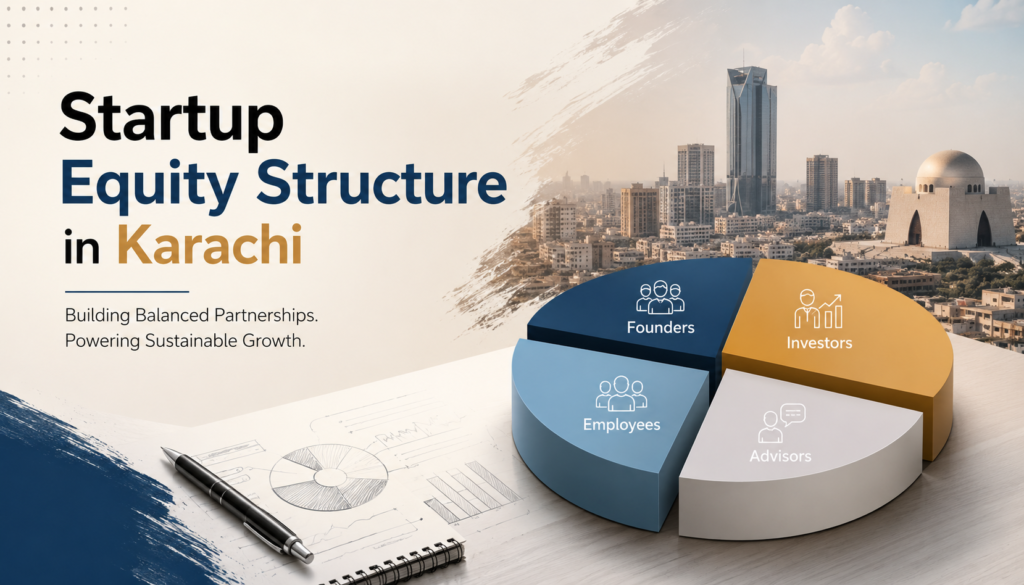
Equity isn’t just ownership it’s motivation, control, and long term commitment.
A smart equity structure helps you.!
keep co-founders aligned
avoid future legal disputes
attract investors and advisors
maintain control during early and growth stages
build a scalable and fundable company
A poor structure, on the other hand, leads to..
1) Founder disputes
2) Massive dilution
3) Lack of investor interest
4) Forced buyouts
5) Unclear decision making authority
Before discussing shares, clarify.
Who is handling tech?
Who is managing business development?
Who is investing money?
Who is contributing full time vs part time?
Who is handling operations or finance?
Two friends from DHA started an e-commerce brand. One built the website, the other managed suppliers. They gave themselves 50/50 equity.
Later, one founder did 80% of the work while the other was barely involved result?
1. Legal conflict
2. Failed partnership
3. Business shut down
Equal equity is NOT always fair equity.
Typical global models.!
50/50 (only when both are equal in everything)
60/40
70/30 based on contribution
Sweat Equity Model (shares for work done instead of money)
Time based contribution equity
But in Pakistan, most founders fail because they rely on verbal agreements rather than documented shareholder agreements.
Founder vesting means shares are earned over time instead of given upfront.
The standard vesting model used by investors worldwide.
4 year vesting
1 year cliff
(If a founder leaves before 12 months, they get nothing.)
Because many founders leave after a few months but still own equity causing permanent hurdles in future investments.
A cap table should list.
each founder
number of shares
percentage ownership
ESOP pool
investor allocation
dilution over time
Without a cap table, your startup risks.!
1. messy shareholding
2. investor rejection
3. unclear ownership rights
In Karachi, most startups struggle to hire talented people early on.
So offer ESOPs to key team members such as.!
CTO
senior developers
marketing lead
early product designers
ESOPs help you attract top talent without paying high salaries.
Equity must be backed by legal documents.
Founders’ Agreement
Shareholders’ Agreement
Vesting Agreement
Intellectual Property Assignment
Non Compete & Non Disclosure Agreement
Most disputes occur simply because founders never formalize anything.
A fintech startup from Clifton had three founders.
One invested capital
One built the tech
One handled marketing
They gave themselves 33/33/33 equity.
Problem?
The marketing co-founder left after six months but kept his 33% shares.
When they approached investors, everyone backed out because:
1. A non active founder owned too much
2. No vesting schedule existed
3. No shareholder agreement was drafted
They spent 1.5 years fixing their structure delaying fundraising by two startup cycles.
MAH&CO. provides end to end startup legal consultancy, including.!
✔ Startup structure planning (Private Limited, LLC, etc.)
✔ Drafting founders’ & shareholder agreements
✔ Creating vesting schedules
✔ Designing fair and investor friendly equity splits
✔ Preparing cap tables for early and growth stage startups
✔ ESOP policy setup
✔ SECP company registration
✔ IP protection and legal compliance
✔ Legal review before fundraising
With MAH&CO., founders avoid costly mistakes and build investor ready companies from day one.
Founders should divide equity based on actual contribution, commitment, skills, domain expertise, financial investment, and long-term involvement. Avoid splitting equity equally by default. A clear, legally documented equity plan with vesting protects the startup from disputes if someone leaves early.
There is no universal formula. Instead of a 50/50 split, many Pakistani startups choose 60/40 or 70/30, depending on who is contributing more time, resources, or leadership. The best split is the one that reflects real responsibilities, not emotions.
Founder vesting ensures that equity is earned over time, not granted upfront. Without vesting, a founder who exits early may still keep a large shareholding, which becomes a major red flag for investors. Proper vesting protects your startup’s future growth, cap table health, and investor confidence.
Yes. Every startup should have a Founders’ Agreement, Shareholders’ Agreement, and a Vesting Schedule. These documents clarify roles, protect ownership, prevent disputes, and make your startup more credible to investors and accelerators — especially in Karachi, where many startups scale quickly.
MAH&CO. provides end-to-end legal support for early-stage companies, including equity allocation, shareholder agreements, vesting arrangements, ESOP planning, cap-table structuring, and SECP compliance. Their startup-focused legal consultants ensure your equity decisions are legally sound, investor-friendly, and scalable.